
Semrush Review 2026: Is It Worth It? Features, Pricing, Pros & Cons Honestly Assessed
📑 Table of Contents
🎯 Quick Verdict
Semrush is the most comprehensive SEO and digital marketing platform available in 2026 — but at $139.95/month for the entry plan, it is also one of the most expensive. Whether it is worth it depends entirely on whether your workflow can extract value from its full breadth of tools, or whether you only need the core SEO features that cheaper alternatives cover at a fraction of the price.
Semrush has been the default recommendation for serious SEO professionals since 2008. In 2026, it remains the tool that over 10 million marketers and 30% of Fortune 500 companies rely on for keyword research, competitor analysis, site audits, and content strategy. But the platform has changed significantly this year — the launch of Semrush One introduces AI Visibility tracking that monitors how your brand appears in ChatGPT, Perplexity, and Gemini answers, not just Google search rankings. That is a genuinely new capability that no other SEO platform currently matches.
This review covers everything: what Semrush actually does, which plan is right for which user, how the new Semrush One AI features work, honest pros and cons, how it compares to Ahrefs and SE Ranking, and a full breakdown of the affiliate program that makes it one of the highest-paying promotions in the digital marketing space. For context on how Semrush fits into a broader AI-powered content workflow, see our AI productivity tools guide. For tools that complement Semrush for content creation, our AI writing tools guide covers the full stack.
📊 Semrush vs Competitors — Feature Score Comparison
What Is Semrush?
Semrush is an all-in-one digital marketing platform founded in 2008. What started as an SEO keyword research tool has grown into a platform covering keyword research, site auditing, backlink analysis, competitor intelligence, content marketing, social media management, PPC research, and — as of 2026 — AI search visibility monitoring. It is used by over 10 million marketing professionals worldwide, including teams at major brands and agencies who need a single platform that eliminates the need to stitch together a dozen separate tools.
The platform’s defining characteristic is comprehensiveness. No single competitor matches the breadth of what Semrush covers under one roof. Ahrefs has a stronger backlink database. SE Ranking is cheaper for core SEO. But neither offers Semrush’s combination of keyword research depth, competitive intelligence, content marketing tools, social media scheduling, PPC analysis, and now AI visibility tracking — all accessible from a single unified dashboard.
Key Features Reviewed
Keyword Magic Tool — Best-in-Class Research
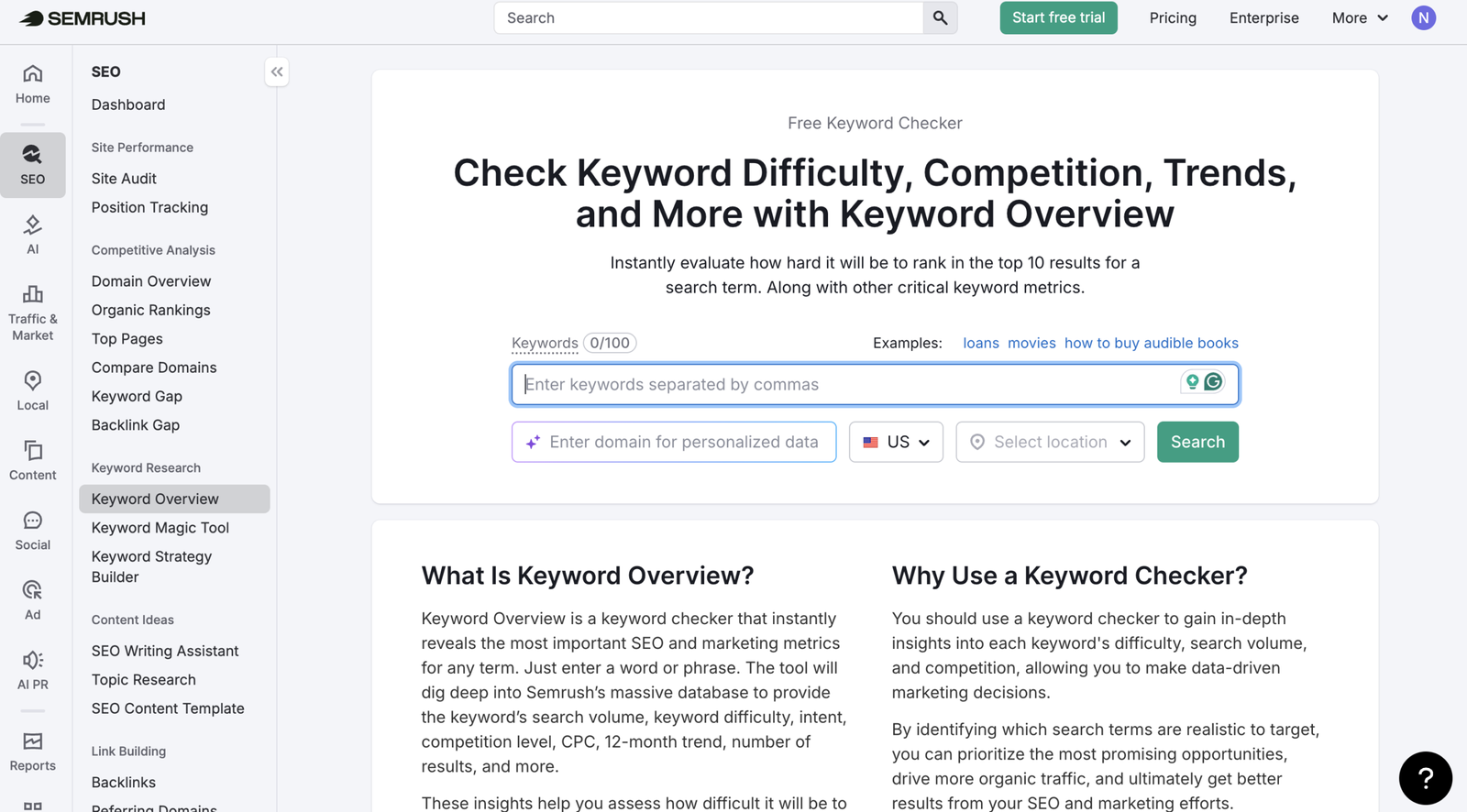
Semrush’s Keyword Magic Tool is widely regarded as the most comprehensive keyword research database available. Type any seed keyword and Semrush generates thousands of related terms, grouped by topic cluster, with search volume, keyword difficulty, CPC data, competitive density, and search intent classification for each. The intent filter — informational, navigational, commercial, transactional — is the most actionable feature for content strategists who need to match content type to search intent, not just search volume.
For a site like NivaaLabs covering AI tools, the Keyword Magic Tool identifies which comparison queries (“cursor vs windsurf”), review queries (“semrush review 2026”), and informational queries (“what is claude code”) have the best combination of traffic potential and ranking difficulty for a newer domain. This is the single most valuable feature for content-first SEO strategies.
Domain Overview & Competitor Analysis — The Playbook Feature
Type any competitor domain into Semrush’s Organic Research tool and the platform returns every keyword they rank for, every page driving their traffic, estimated monthly organic visitors, and the top backlink sources sending them authority. For affiliate site builders and content marketers, this is the primary workflow: find a site monetising the same audience you target, analyse their top-performing pages, and build better versions targeting the same keywords.
The Traffic Analytics tool goes further — showing estimated total traffic, traffic sources, bounce rate, pages per visit, and audience demographics for any domain. This level of competitive intelligence is not replicable through free tools and is one of the clearest justifications for Semrush’s premium price point for agencies managing multiple client campaigns.
Site Audit — Technical SEO at Scale
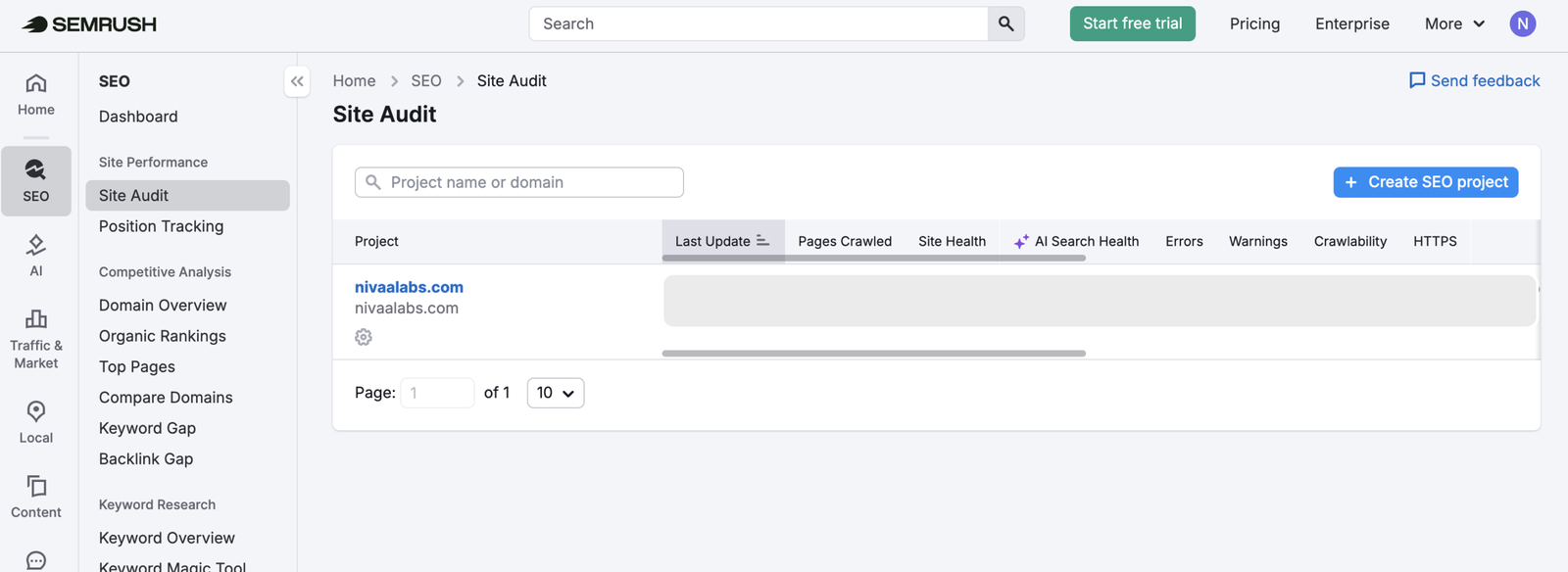
Semrush’s Site Audit crawls your entire website and returns a prioritised list of every technical SEO issue — broken links, missing meta tags, duplicate content, slow pages, Core Web Vitals problems, missing canonical tags, and more — ranked by impact severity. The Pro plan audits up to 100,000 pages per month. Guru and Business scale to 300,000 and 1,000,000 pages respectively.
The audit runs on a schedule — daily, weekly, or monthly — and alerts you when new issues appear. For WordPress sites like NivaaLabs running automated content pipelines, this is essential: new posts can introduce duplicate meta descriptions, missing alt tags, or broken internal links that compound quietly over time. A weekly audit catches these before they affect rankings.
Position Tracking — Daily Ranking Monitoring
Semrush’s Position Tracking monitors your keyword rankings daily across desktop and mobile, in any country, city, or device combination. Set up a project, add your target keywords, and Semrush tracks exactly where you rank in Google — and alerts you when positions change significantly. The Pro plan tracks 500 keywords daily. Guru tracks 1,500. Business tracks 5,000.
The Visibility Score — a single percentage that aggregates your rankings across all tracked keywords — is the metric that clients and stakeholders understand most intuitively. Agencies use it to demonstrate SEO progress without requiring clients to interpret individual keyword ranking changes.
Backlink Analytics — Authority Building Intelligence
Semrush’s backlink database contains hundreds of billions of indexed links and updates daily. The Backlink Analytics tool shows every site linking to you or your competitors, anchor text distribution, referring domain authority, and toxic backlink identification. The Backlink Gap tool finds sites linking to your competitors but not to you — the most actionable link building research workflow available in any SEO platform.
Semrush One — The New AI Visibility Plan
The most significant Semrush development in 2026 is the launch of Semrush One — a unified plan that combines the full classic SEO toolkit with a new AI Visibility layer. This is the feature that justifies attention from anyone building content in 2026, because it addresses a problem that Google Search Console and traditional rank trackers cannot: how does your brand appear in AI-generated answers?
When someone asks ChatGPT, Perplexity, or Google’s AI Overviews a question in your niche, does your brand get mentioned? Is it your latest content they reference, or an outdated piece from 2024? Are your competitors appearing where you are not? Semrush One’s AI Brand Performance feature answers all of these questions — showing your AI Visibility Score, which topics AI systems associate you with, which competitors appear alongside you, and whether the AI tools are drawing on your current content or older material.
Semrush One pricing starts at $199/month — which sounds expensive until you compare it to buying the classic SEO plan ($139.95/month) plus the AI Visibility add-on ($99/month) separately. The combined price is $238.95/month. Semrush One at $199/month saves $40 every month, with greater savings at higher tiers on annual billing.
Semrush One Pricing (2026)
| Plan | Monthly | Annual (per month) | Projects | Keywords Tracked | AI Features |
|---|---|---|---|---|---|
| Semrush One Starter | $199/mo | ~$165/mo | 5 | 500 | AI Visibility + Brand Monitoring |
| Semrush One Pro+ | $299/mo | ~$249/mo | 15 | 1,500 | Full AI toolkit + Content tools |
| Semrush One Advanced | $499/mo | ~$416/mo | 40 | 5,000 | API + MCP Access + max limits |
Full Pricing Breakdown 2026
Semrush has two pricing tracks in 2026: the classic SEO toolkit plans for users who only need traditional SEO features, and Semrush One for users who want both SEO and AI visibility in a single platform.
Classic SEO Toolkit Plans
| Plan | Monthly | Annual (per month) | Projects | Keywords | Best For |
|---|---|---|---|---|---|
| Pro | $139.95/mo | $117.33/mo | 5 | 500/day | Freelancers, small businesses, beginners |
| Guru | $249.95/mo | $208.33/mo | 15 | 1,500/day | Agencies, content marketers, growing businesses |
| Business | $499.95/mo | $416.66/mo | 40 | 5,000/day | Large agencies, enterprises, API integrations |
Plan Feature Comparison
| Feature | Pro | Guru | Business |
|---|---|---|---|
| Projects | 5 | 15 | 40 |
| Keywords Tracked | 500/day | 1,500/day | 5,000/day |
| Site Audit Pages | 100K/mo | 300K/mo | 1M/mo |
| Results per Report | 10,000 | 30,000 | 50,000 |
| Content Marketing Platform | ❌ | ✅ | ✅ |
| Historical Data | ❌ | ✅ (12 months) | ✅ (full) |
| Looker Studio Integration | ❌ | ✅ | ✅ |
| API Access | ❌ | ❌ | ✅ |
| Share of Voice | ❌ | ❌ | ✅ |
| Free Trial | ✅ 14 days | ✅ 14 days | ❌ |
Who Is Semrush For?
Semrush is the right tool when organic search is a primary revenue driver and you need more than keyword research alone. The clearest use cases are SEO agencies managing multiple client campaigns, in-house marketing teams at businesses with dedicated SEO budgets, and content site operators building systematic SEO-driven content operations.
Semrush is not the right tool for bloggers just getting started, small businesses with minimal SEO budgets, or developers who only need occasional keyword lookups. At $139.95/month for the entry plan, Semrush requires that SEO be a meaningful revenue driver to justify the cost. Tools like SE Ranking ($65/month) or Mangools ($38/month) cover the core SEO functionality that most small sites actually need at 30–50% of the price. The entry price of $165/month is 3–5x higher than capable alternatives — the premium is justified by comprehensiveness and data depth, not by any single feature that cheaper tools lack.
Semrush vs Alternatives
| Tool | Starting Price | Best For | Semrush Advantage | Semrush Disadvantage |
|---|---|---|---|---|
| Semrush | $139.95/mo | Full SEO + content agencies | — | Most expensive entry point |
| Ahrefs | $129/mo | Backlink analysis specialists | Better content tools, competitor intel | Ahrefs has stronger backlink DB |
| SE Ranking | $65/mo | Budget-conscious teams | Far more comprehensive overall | SE Ranking is 2x cheaper |
| Mangools | $38/mo | Beginner bloggers | Semrush is significantly more powerful | Mangools is 3.5x cheaper |
| Moz Pro | $99/mo | Link building focus | More tools, deeper keyword data | Moz has stronger DA metric trust |
Semrush Affiliate Program — The Numbers
Semrush runs one of the highest-paying affiliate programs in the digital marketing space, and it is the main reason NivaaLabs covers it in depth. Here is exactly what the program pays and how it works.
Commission Structure
| Action | Commission | Notes |
|---|---|---|
| New subscription (any plan) | $200 flat | One-time CPA — same regardless of plan selected |
| Free trial activation | $10 | Paid even if the user never subscribes |
| Silver tier (5–19 sales/quarter) | Higher rates | Unlocks at 5 sales per quarter |
| Gold tier (20–49 sales/quarter) | Premium rates | Up to $300–$450 per sale at top tiers |
| Platinum tier (50+ sales/quarter) | Maximum + bonuses | Custom negotiated CPA available |
The 120-day cookie window is the most affiliate-friendly aspect of the program. A reader can click your affiliate link in January, research Semrush for three months, and convert in April — you still earn the $200 commission. Most SaaS affiliate programs use 30-day cookies. Semrush’s 4-month window dramatically increases the probability of capturing delayed purchase decisions, which are extremely common with premium B2B software. The program is managed through Impact.com with monthly payouts via bank transfer or PayPal once commissions are locked and the refund period clears.
Pros and Cons
✅ Pros
- Most Comprehensive Platform Available: No single competitor matches the breadth of Semrush — keyword research, site auditing, backlink analysis, competitor intelligence, content marketing tools, social media scheduling, PPC research, and now AI visibility tracking are all accessible from one dashboard. For agencies that previously needed 4–6 separate tools, Semrush genuinely reduces stack complexity.
- Semrush One AI Visibility Is Genuinely New: The ability to track how your brand appears in ChatGPT, Perplexity, and Google AI Overviews answers — not just Google rankings — is a feature category that no other major SEO platform currently matches. For content sites operating in AI-dominated niches, this is increasingly relevant to how content strategy is developed.
- Best Competitor Intelligence Available: The Organic Research and Traffic Analytics tools provide a level of competitive insight — traffic estimates, keyword portfolios, top pages, audience demographics — that is more accurate and actionable than any competing platform. For content strategy built on competitive gap analysis, this is Semrush’s clearest advantage.
- 14-Day Free Trial on Pro and Guru: Unlike Ahrefs which eliminated free trials entirely, Semrush offers a 14-day free trial on Pro and Guru plans with full feature access. This is a genuine evaluation period — enough time to run a full site audit, research a content strategy, and assess whether the platform delivers value for your specific workflow.
- Best SEO Affiliate Program Available: The $200 flat commission per new subscription, $10 per trial activation, 120-day cookie window, and tiered loyalty program that scales to $300–$450 per sale make this one of the highest-paying affiliate programs in digital marketing. For content sites with an SEO-aware audience, the monetisation potential is substantial.
- Trusted by 30% of Fortune 500 Companies: Brand credibility matters for affiliate conversion. When you recommend a tool that 30% of Fortune 500 companies use, your audience’s purchase confidence is significantly higher than it would be for a newer or less established platform.
❌ Cons
- Most Expensive Entry Point of Any Major SEO Tool: At $139.95/month ($117.33/month annual), Semrush is 3–5x more expensive than capable alternatives like SE Ranking ($65/month) or Mangools ($38/month) that cover 80% of the features most small businesses actually use. For freelancers, bloggers, and small businesses, the cost is difficult to justify when cheaper tools cover the core workflows.
- Content Marketing Platform Locked Behind Guru Plan: The Pro plan deliberately excludes the SEO Content Template, Topic Research, and SEO Writing Assistant — the tools most content marketers actually want. Accessing them requires upgrading to Guru at $249.95/month, effectively making $139.95/month the wrong entry price for content-focused users.
- Steep Learning Curve for Full Suite: Semrush has dozens of tools, each with its own interface, metrics, and workflows. New users who try to use everything at once get overwhelmed. The platform delivers value when you pick one workflow — keyword research and content planning, or site audit and technical SEO — master it, and expand gradually. Users who expect immediate value across all features are consistently disappointed.
- No Free Plan — Only a Trial: Unlike Google Search Console, Ahrefs Webmaster Tools, or Ubersuggest, Semrush has no permanently free tier. The 14-day trial requires a credit card, and billing starts automatically after the trial period unless cancelled. For users still evaluating whether SEO investment is right for their business, this creates a commitment barrier.
- API Access Only on Business Plan: Developers and data teams who need to integrate Semrush data into internal dashboards, reporting tools, or automated workflows must subscribe to the Business plan at $499.95/month. The API is not available on Pro or Guru — a meaningful limitation for technical teams that want programmatic access without paying enterprise prices.
Final Verdict — Is Semrush Worth It in 2026?
Semrush is worth it when your workflow demands comprehensiveness and your business has the budget to match. For SEO agencies managing multiple client campaigns, the reduction in tool sprawl alone — replacing separate keyword research, site audit, backlink analysis, and content tools with one platform — justifies a significant portion of the cost. For in-house marketing teams where organic search drives measurable revenue, the competitive intelligence and keyword research depth have no equivalent at any price point.
Semrush is not worth it for everyone. At $139.95/month for the Pro plan — which does not even include the Content Marketing Platform — it is a hard sell for freelancers, bloggers, and small businesses where SEO is one activity among many rather than a primary revenue channel. SE Ranking at $65/month or Mangools at $38/month cover keyword research, rank tracking, and site auditing for the majority of small site operators at a fraction of the price. The honest recommendation: if you are spending more than $5,000/month on content creation and SEO as a business line, Semrush Pro or Guru is likely the right investment. If you are spending less, start with a cheaper alternative and upgrade when you hit its limits.
The new Semrush One AI Visibility feature changes the calculus for one specific audience: content sites operating in AI search-dominated niches where ranking in ChatGPT and Perplexity answers is as strategically important as ranking in Google. For NivaaLabs covering AI tools and productivity, monitoring whether our brand appears when someone asks an AI assistant about “best AI coding tools” or “Claude vs ChatGPT” is genuinely relevant to long-term content strategy — and Semrush One is currently the only platform that provides this data at scale.
Try Semrush Free for 14 Days
Start Free 14-Day Trial → View All Plans & Pricing →No commitment — full feature access on Pro and Guru plans during trial. Cancel anytime.
❓ Frequently Asked Questions
How much does Semrush cost in 2026?
Semrush classic plans start at $139.95/month (monthly) or $117.33/month (annual) for the Pro plan. The Guru plan is $249.95/month ($208.33/month annual). The Business plan is $499.95/month ($416.66/month annual). Semrush One — which adds AI Visibility tracking — starts at $199/month ($165/month annual). All plans include a 14-day free trial except Business.
Is Semrush worth it for small businesses?
For most small businesses, Semrush is not worth the entry price of $139.95/month. Cheaper alternatives like SE Ranking ($65/month) or Mangools ($38/month) cover keyword research, rank tracking, and site auditing for a fraction of the cost. Semrush is worth it when organic search is a primary revenue driver and you need the competitive intelligence, content marketing platform, and data depth that cheaper tools do not offer.
What is Semrush One?
Semrush One is the new unified plan launched in 2026 that combines the full classic SEO toolkit with an AI Visibility layer. The AI Visibility feature tracks how your brand appears in ChatGPT, Perplexity, Gemini, and Google AI Overviews answers — showing your AI Visibility Score, which topics AI systems associate you with, and how you compare to competitors in AI-generated results. Pricing starts at $199/month, which is cheaper than buying the classic plan and AI Visibility add-on separately.
Does Semrush have a free plan?
No. Semrush does not offer a permanently free plan. All plans are paid subscriptions. However, the Pro and Guru plans include a 14-day free trial with full feature access — no limitations during the trial period. A credit card is required to start the trial, and billing begins automatically after 14 days unless cancelled.
How much does the Semrush affiliate program pay?
The Semrush affiliate program pays a flat $200 commission for every new subscription and $10 for every free trial activation. The cookie duration is 120 days — meaning you earn the commission if a user purchases within four months of clicking your link. A tiered loyalty program pays $300–$450 per sale at Gold and Platinum performance levels. The program is managed through Impact.com with monthly payouts.
Is Semrush better than Ahrefs?
It depends on your primary use case. Ahrefs has a larger and more frequently updated backlink database — the best in the industry for link building research. Semrush has better keyword research tools, more comprehensive competitor intelligence, a content marketing platform, and now AI visibility tracking. For pure backlink analysis, Ahrefs leads. For an all-in-one marketing platform, Semrush covers more ground. Both start at approximately $130–140/month.
Which Semrush plan is best for bloggers and content creators?
The Guru plan at $208.33/month (annual) is the best choice for bloggers and content creators who intend to use Semrush seriously. It unlocks the Content Marketing Platform — including the SEO Content Template, Topic Research, and SEO Writing Assistant — that the Pro plan deliberately excludes. Without these tools, the Pro plan is primarily a keyword research and audit tool, not a content strategy platform. However, for bloggers not yet generating significant SEO-driven revenue, cheaper alternatives like SE Ranking or Mangools may be more appropriate starting points.
Latest Articles
Browse our comprehensive AI tool reviews and productivity guides
Cursor Composer 2 vs Claude Code 2026: Which Wins?
Cursor Composer 2 vs Claude Code 2026: Which Wins?
Compare Cursor Composer 2 vs Claude Code (Opus 4.6) in 2026. Discover benchmarks, pricing, key features, and which AI coding tool wins for developers.
Cursor Composer 2 Review 2026: Is It the Best AI Coding Model?
Cursor Composer 2 Review 2026: Is It the Best AI Coding Model?
Explore Cursor Composer 2 in 2026: a deep dive into its unique features, pricing, and performance to assess if it's the leading AI coding model for developers.
Best AppSumo AI Deals in 2026: Lifetime Tools Worth Every Penny (Updated...
Best AppSumo AI Deals in 2026: Lifetime Tools Worth Every Penny (Updated Monthly)
AppSumo's AI category is exploding in 2026 — but not every lifetime deal is worth grabbing. We've curated the best AI tools available right now with real prices, honest verdicts, and exactly who each deal is for.
8 Real Ways Companies Are Using Synthesia in 2026 That Will Genuinely...
8 Real Ways Companies Are Using Synthesia in 2026 That Will Genuinely Surprise You
From a Cannes Lion-winning Messi campaign to banks running AI-powered angry customer simulations — here are 8 real Synthesia projects that go way beyond "training videos.
Grammarly Review 2026: Who Actually Needs It (And Who Doesn’t)
Grammarly Review 2026: Who Actually Needs It (And Who Doesn’t)
Grammarly is one of the most widely installed writing tools on the internet — but is it actually worth paying for in 2026? We break down exactly who gets real value from Grammarly Pro, who's fine staying free, and who should skip it entirely.
Canva Pro vs Free 2026: Is the Upgrade Actually Worth $15/Month?
Canva Pro vs Free 2026: Is the Upgrade Actually Worth $15/Month?
Canva's free plan is genuinely generous — but Pro unlocks tools that change what's possible. We break down every key difference by user type so you know exactly whether $15/month is worth it for you.
Writesonic vs Jasper 2026: Stop Guessing — This Comparison Ends the Debate
Writesonic vs Jasper 2026: Stop Guessing — This Comparison Ends the Debate
Writesonic and Jasper are both solid AI writing tools — but they're built for completely different workflows. Features, pricing, SEO, and GEO compared so you know exactly which one belongs in your stack.
Semrush Review 2026: Is It Worth It? Features, Pricing, Pros & Cons...
Semrush Review 2026: Is It Worth It? Features, Pricing, Pros & Cons Honestly Assessed
Semrush is still the most comprehensive SEO platform available in 2026 — but at $139.95/month for the entry plan, it is not right for everyone. This honest review covers every pricing plan, the new Semrush One AI Visibility feature that tracks your brand in ChatGPT and Perplexity, how it compares to Ahrefs and SE Ranking, and exactly who should and should not pay for it. Plus: a full breakdown of the $200 affiliate commission and 120-day cookie that makes it one of the best programs in digital marketing.
7 Best ChatGPT Alternatives in 2026: We Tested Every One (Free +...
7 Best ChatGPT Alternatives in 2026: We Tested Every One (Free + Paid Options)
ChatGPT is no longer the best AI at any single thing — and in March 2026, the alternatives have genuinely caught up. Whether you need better coding (Claude), smarter research with citations (Perplexity), a completely free option with no daily limits (DeepSeek), or a 2 million token context window at no cost (Google Gemini), there is a more specialised tool for every job. We tested all 7 — here is exactly which one is right for your workflow.
Cursor Composer 2 vs Claude Opus 4.6 vs Sonnet 4.6 in 2026:...
Cursor Composer 2 vs Claude Opus 4.6 vs Sonnet 4.6 in 2026: Which Model Should You Use for Agentic Coding?
Cursor Composer 2 vs Claude Opus 4.6 vs Sonnet 4.6 — The smartest dev tools just leveled up. See which AI model actually codes, plans, and ships like a teammate—not just a chatbot.
Cursor vs Windsurf vs Claude Code in 2026: Which AI Coding Tool...
Cursor vs Windsurf vs Claude Code in 2026: Which AI Coding Tool Should You Use?
Cursor vs Windsurf vs Claude Code is the defining AI coding tool comparison of 2026 — three tools built on fundamentally different philosophies, targeting overlapping developer audiences at nearly identical price points, but delivering very different day-to-day experiences
Claude Dispatch Review 2026: Anthropic’s Remote AI Agent — Setup, Use Cases,...
Claude Dispatch Review 2026: Anthropic’s Remote AI Agent — Setup, Use Cases, Limits & Is It Worth It?
Claude Dispatch launched March 17, 2026 — send tasks from your phone, your desktop executes them locally, you come back to finished work. Setup takes 2 minutes. Current reliability is ~50% on complex tasks. Here is everything you need to know before relying on it.