
Claude Code vs OpenCode in 2026: Is the Free Open-Source Alternative Worth It for Developers?
📑 Table of Contents
🎯 Quick Verdict
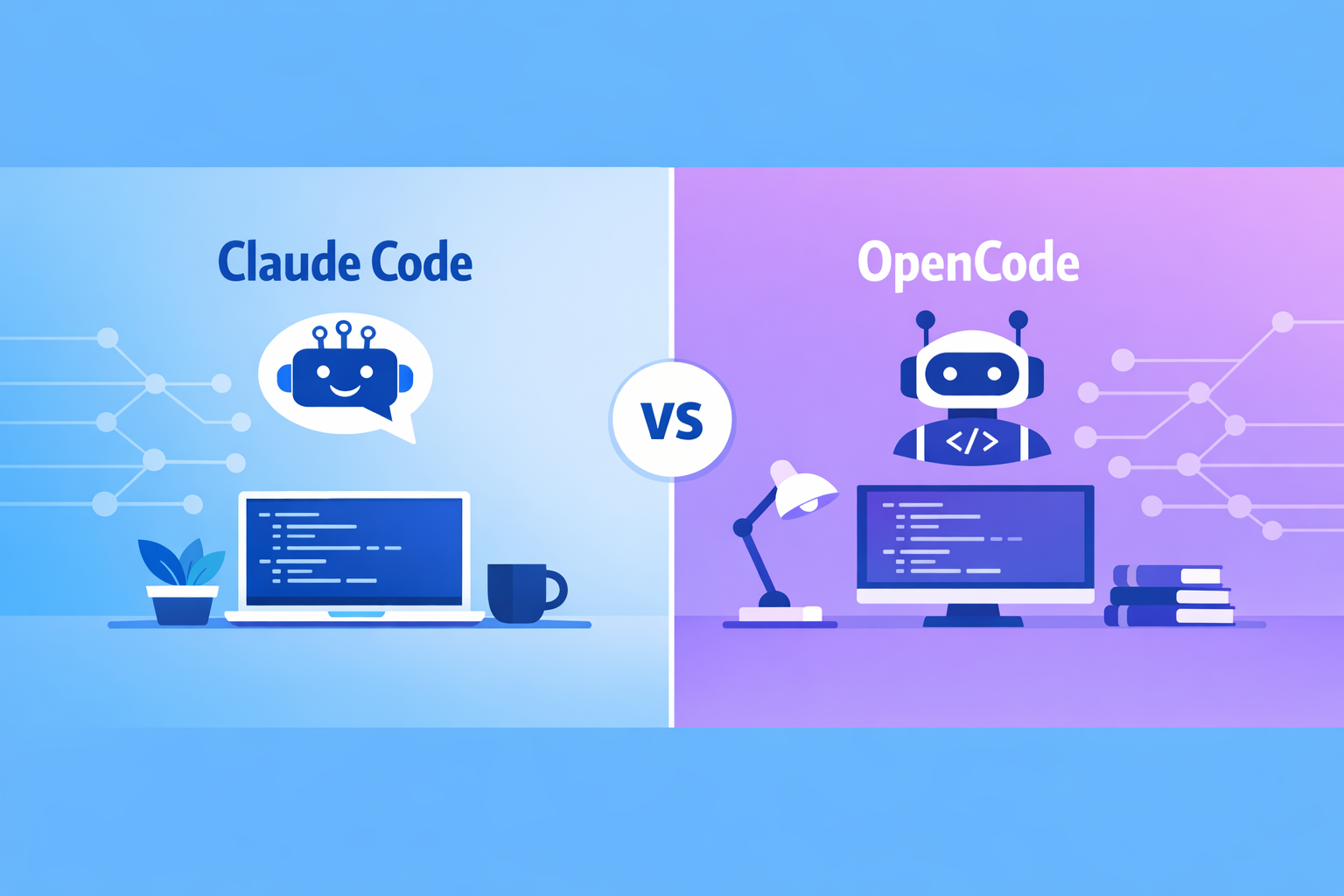
Claude Code vs OpenCode is the defining terminal AI coding debate of 2026 — Anthropic’s polished proprietary tool versus a fast-growing open-source alternative with 112K GitHub stars. One offers best-in-class model integration and production polish; the other offers model freedom, zero tool cost, and full data sovereignty.
The terminal AI coding space in 2026 has a clear rivalry at its centre: Claude Code, Anthropic’s official agentic coding CLI, versus OpenCode, the open-source community alternative that has grown to over 112,000 GitHub stars and 2.5 million monthly active developers. Both tools live in the terminal, both can read entire codebases, execute commands, manage Git operations, and complete autonomous multi-step coding tasks. The difference is philosophy, cost, and the consequences of Anthropic’s January 2026 OAuth policy change that officially severed OpenCode’s ability to use Claude subscriptions directly.
This comparison is grounded in real benchmark data, actual pricing, and the community developer experience as of March 2026 — not marketing copy from either side. We cover what each tool does well, where each one falls short, and exactly which type of developer should choose which. For broader context on where Claude Code fits within Anthropic’s full product lineup, see our Claude plans comparison guide. For a wider look at the AI coding assistant landscape, our guide to the best AI coding assistants for 2026 covers additional alternatives including Cursor, GitHub Copilot, and Codeium.
⚡ GitHub Stars Growth: Claude Code vs OpenCode
Overview: Two Tools, Two Philosophies
Claude Code launched in February 2025 as Anthropic’s official terminal-based agentic coding tool. It quickly became the most-used AI coding tool among surveyed developers by February 2026, accounting for 4% of all public GitHub commits at a rate of 135,000 per day . OpenCode emerged from the SST team as a direct community response — an open-source, model-agnostic alternative that decouples the terminal interface from the AI model, letting developers bring their own API keys and choose from over 75 providers.
The relationship between the two tools became openly adversarial on January 9, 2026. Anthropic silently blocked OpenCode from using Claude via consumer OAuth tokens. OpenCode removed Claude Pro/Max support from the codebase, citing “anthropic legal requests.” The developer backlash on Hacker News was immediate and fierce. OpenCode responded by launching Black and Zen — its own gateway tiers — while OpenAI publicly welcomed third-party tools as counter-positioning, calling out Anthropic’s approach by name. You can still use Claude models in OpenCode via direct API keys; the block specifically targets OAuth-based subscription access.
Claude Code
Claude Code is Anthropic’s official terminal-based agentic coding CLI, available to Claude Pro ($20/month), Max ($100–$200/month), Team, and Enterprise subscribers. It runs exclusively on Anthropic’s Claude models — Opus 4.6 and Sonnet 4.6 — and is designed as a vertical integration between Anthropic’s model intelligence and an agentic coding loop. It requires no API key configuration beyond authenticating with your Claude subscription. It has no desktop app — terminal only. Its SWE-bench Verified score of 57.5% (Pro tier with Sonnet 4.6, as reported by independent testers) places it among the top-performing agentic coding tools available.
OpenCode
OpenCode is an open-source agent that helps you write code in your terminal, IDE, or desktop. With over 120,000 GitHub stars, 800 contributors, and over 10,000 commits, OpenCode is used and trusted by over 5M developers every month. Its core philosophy is BYOK — Bring Your Own Key. OpenCode is an open-source terminal AI coding assistant driven by the community, featuring a beautiful TUI interface, multi-agent architecture, and 75+ model provider support. Its core philosophy is BYOK — developers only pay API costs with no extra subscription. It supports OpenAI, Anthropic (via API key), Google Gemini, AWS Bedrock, Azure, Groq, Mistral, Cohere, and any OpenAI-compatible endpoint including local models via Ollama or LM Studio. A desktop app is available for macOS, Windows, and Linux.
The two tools represent genuinely different philosophies: Claude Code is a vertical integration masterpiece. OpenCode is a horizontal flexibility play. Understanding which philosophy matches your workflow, budget, and values is the most important step in making the right choice.
Key Features Compared
Both tools share a common baseline — terminal interface, codebase-wide context, file editing, command execution, and Git integration. The differences that matter for real daily use are in model access, MCP tool handling, architecture, privacy controls, and the quality of the agentic loop itself.
Claude Code: Tightly Integrated Agentic Loop with Checkpoint System
Claude Code’s defining technical strength is the quality and reliability of its agentic loop — the cycle of reading context, planning actions, executing changes, and verifying results. Claude Code uses a 2,896-token core system prompt with 20 built-in tool descriptions and specialized subagent prompts (Plan: 633 tokens, Explore: 516 tokens, Task: 294 tokens). These purpose-built subagent prompts are the key to Claude Code’s consistency — rather than a single general-purpose agent handling everything, specific subagents are invoked for planning, exploration, and task execution, each optimized for their role. The checkpoint system saves verified states before making changes, enabling rollback if a modification introduces a regression. This level of engineering discipline in the agentic loop is what made Claude Code jump from nowhere to the number one most-used AI coding tool among surveyed developers by February 2026. For developers who want a tool that works reliably on production codebases without manual intervention in the agent’s decision-making, Claude Code’s integrated architecture delivers a consistently higher floor of quality.
OpenCode: 75+ Model Providers with Declarative MCP Tool Management
OpenCode’s defining technical advantage is its model-agnostic architecture combined with a declarative approach to MCP tool management that keeps context cleaner than Claude Code’s current implementation. OpenCode treats tools more like dependencies in a package.json. You set them up in opencode.jsonc and use glob patterns to control who sees what. This declarative style keeps the context clean. You can inject specific tools only into the agents that need them, instead of dumping the whole kitchen sink into every conversation. This matters practically for developers working with multiple MCP servers — a database tool, a browser tool, and a code search tool should not all be loaded into every conversation context, and OpenCode’s configuration model handles this elegantly. The multi-provider support means developers can switch from Claude Sonnet for complex architectural reasoning to Gemini Flash for rapid file scanning to a local Mistral model for sensitive code — all within the same tool without reconfiguring their environment.
Claude Code: Model Performance and SWE-bench Results
On objective coding benchmarks, Claude Code with Opus 4.6 leads the field. Independent testing reports a SWE-bench Verified score of 57.5% — a measure of how accurately the tool can resolve real GitHub issues autonomously. If you prefer convenience and a tool that just works out of the box, pick Claude Code. The tight coupling between Anthropic’s model training and Claude Code’s system prompts means the model has been specifically optimized for the tool’s agentic patterns — a calibration advantage that third-party tools accessing the same model via API cannot fully replicate. For production engineering tasks where the quality of the first attempt matters — complex refactoring, architectural changes, debugging obscure failures — Claude Code’s model integration delivers measurably better results than OpenCode with equivalent models.
OpenCode: Air-Gapped Mode and Full Data Sovereignty
OpenCode offers true privacy. For developers in defence, healthcare, and fintech, it is not always possible to send data to the cloud due to regulations and customer privacy. OpenCode creates an “Air-gapped Mode” that lets you use it with open-source models through Ollama. This is a capability Claude Code cannot match by design — as a proprietary cloud tool, all code context is sent to Anthropic’s servers. For organizations operating under SOC 2, HIPAA, or government security frameworks, this is not a nice-to-have but a hard requirement that immediately eliminates Claude Code as an option regardless of its quality. OpenCode’s MIT license also means organizations can audit the full source code, run security assessments, and modify the tool for their specific compliance needs — a level of transparency that closed-source tools fundamentally cannot offer.
Claude Code: Faster Security Patching and Production Stability
As an actively maintained proprietary tool backed by Anthropic’s engineering team, Claude Code ships security patches on a faster cycle than OpenCode’s community-driven maintenance model. Two CVEs were found in early 2026, one allowing arbitrary code execution through untrusted project hooks (CVSS 8.7), another allowing API key exfiltration from crafted repositories (CVSS 5.3). Both were patched in current versions. For enterprise teams where security compliance is audited and CVE response time is measured, Anthropic’s dedicated engineering resources represent a meaningful reliability advantage. OpenCode’s open-source model means community contributors identify and patch vulnerabilities, but the timeline is less predictable and the patching process less coordinated than a dedicated security team.
OpenCode: Workspaces and Persistent Context Architecture
OpenCode is building toward a Workspaces feature, powered by its client/server architecture, that aims to persist context even when you close your laptop. This is something Claude Code’s simpler CLI design can’t easily support, and it’s one of the most anticipated features the community is rallying around. The client/server architecture that enables this is a fundamental design difference — OpenCode’s server process can maintain state across sessions, while Claude Code’s simpler CLI design requires rebuilding context at the start of each session. For developers working on long-running projects where re-establishing codebase context at the start of each session adds meaningful overhead, OpenCode’s architectural trajectory offers a clear advantage once Workspaces reaches full release.
Pricing Breakdown
The pricing comparison between Claude Code and OpenCode is more nuanced than “paid vs free” — OpenCode is free as a tool but you still pay for the AI models you connect to. The real comparison is total cost of ownership across different usage patterns.
| Cost Factor | Claude Code | OpenCode |
|---|---|---|
| Tool Cost | $20–$200/month (subscription required) | $0 (MIT open-source) |
| Model Cost | Included in subscription | Pay per API token (BYOK) |
| Free Model Option | ❌ No free models | ✅ Gemini free tier = $0 total |
| Claude Access | ✅ Subscription included | API key only ($15–25/month typical) |
| Local Models (Ollama) | ❌ Not supported | ✅ Fully supported, $0 cost |
| Pro Plan | $20/month (5x Free usage) | OpenCode Black: $20/month gateway |
| Heavy Usage | $100–$200/month (Max tier) | API costs: ~$15–50/month typical |
| Team of 5 (est.) | $500–$1,500/month | $75–$250/month (API costs only) |
| Enterprise | Custom (Team Premium: $150/seat) | Self-hosted, infrastructure costs only |
The truly free scenario with OpenCode is using Google Gemini 2.5 Pro via Google AI Studio’s free tier — with Gemini 3.1 Pro via Google AI Studio’s free tier, the total cost is $0 per month. For developers who are comfortable with Gemini’s coding performance, this is a genuine zero-cost professional coding agent. The catch is that Gemini’s performance on complex architectural tasks trails Claude Opus 4.6, so the “free” option involves a real capability trade-off on the hardest tasks.
For developers who want Claude’s model quality through OpenCode, using Claude Sonnet 4.6 via the Anthropic API at typical development usage costs roughly $15–25/month — comparable to Claude Code Pro but without usage limits. This is arguably the most interesting pricing scenario — similar monthly cost to Claude Code Pro, but with no hard usage ceiling, making it better value for heavy users who regularly hit Pro’s limits.
At the enterprise scale, the cost differential becomes substantial. For a 5-person engineering team all running Claude Code as their primary tool, budget $500–$1,500/month conservatively. The same team on OpenCode with API-based Claude access would spend $75–$250/month — a 60–85% cost reduction. OpenCode costs zero dollars as a tool. Claude Code costs $17–100 per month per developer, plus API usage on top. For one developer, that’s manageable. For a team of 50? That’s $850–5,000 monthly before API costs. For teams also looking to optimize their broader AI spend, our AI data analysis tools guide covers cost-effective options for the analytics side of the stack.
Best Use Cases
The right tool depends not just on features and cost but on the specific professional context — team size, compliance requirements, model preferences, and how much setup overhead is acceptable.
Use Case 1: Solo Developer on a Budget — OpenCode + Free Gemini
Problem: An independent developer or freelancer wants a professional-grade agentic coding tool but cannot justify $20–100/month on top of existing tool subscriptions, particularly for side projects or early-stage work where income is inconsistent.
Solution: Install OpenCode and connect it to Google Gemini 2.5 Pro via Google AI Studio’s free tier. Total monthly tool cost: $0. OpenCode handles file editing, terminal execution, Git operations, and multi-step task completion using Gemini as the underlying model — all the core agentic coding capabilities without any subscription commitment.
Outcome: A fully functional agentic coding environment at zero cost. Gemini 2.5 Pro performs well on standard coding tasks — CRUD operations, bug fixing, test writing, and feature implementation — making the free tier genuinely useful rather than a crippled demo. For the hardest architectural tasks, the developer can add a pay-as-you-go Claude or GPT API key for specific sessions without a recurring commitment.
Use Case 2: Professional Developer Wanting Best Model Quality — Claude Code Pro
Problem: A professional developer working on production codebases needs the most reliable and highest-quality agentic coding tool available, with minimal setup friction and maximum confidence in the output quality on complex tasks.
Solution: Claude Code on the Pro plan ($20/month) provides the highest-quality agentic coding loop available, with Sonnet 4.6’s SWE-bench performance, Anthropic’s refined system prompts, and a production-stable tool backed by dedicated engineering support. Authentication is a single login — no API key management, no provider configuration.
Outcome: The developer gets a tool that consistently performs at the top of benchmark tables on complex real-world coding tasks, with the reliability and support of a professionally maintained product. For developers billing their time at professional rates, the $20/month cost is recovered in minutes of saved debugging time per week. For context on how Claude Code fits within the full Claude ecosystem, our Claude plans comparison covers all tiers and their relative value.
Use Case 3: Healthcare, Fintech, or Defence Developer — OpenCode Air-Gapped
Problem: A developer at a regulated organization cannot send source code to external cloud APIs due to data sovereignty requirements, HIPAA compliance, or government security frameworks — eliminating Claude Code as an option regardless of its quality.
Solution: OpenCode in Air-Gapped Mode with local models via Ollama. The entire stack runs on the organization’s own hardware — no code leaves the building. OpenCode’s MIT license allows full source code audit and modification for compliance documentation. Codestral or DeepSeek Coder running locally via Ollama provides capable coding assistance without any external API dependency.
Outcome: A fully compliant AI coding environment with complete data sovereignty. Local model quality trails Claude Opus 4.6 on the most complex tasks, but for the class of organizations where compliance is non-negotiable, the choice is OpenCode local or no AI coding tool at all — Claude Code is not on the table.
Use Case 4: Engineering Team Optimizing for Cost at Scale — OpenCode + API Keys
Problem: A startup engineering team of 8–15 developers wants to adopt AI-assisted coding across the entire team but finds Claude Code’s per-developer subscription cost ($160–$1,500/month for the team) difficult to justify against other infrastructure spend priorities.
Solution: Deploy OpenCode team-wide using shared API keys or individual developer API keys with organization billing. Use Claude Sonnet 4.6 via API for complex tasks and Gemini Flash for rapid, simpler operations — switching models based on task complexity to optimize API spend. Total team cost: $150–$400/month in API fees versus $400–$1,500/month for equivalent Claude Code subscriptions.
Outcome: The team adopts AI-assisted coding at 60–80% lower cost with model flexibility to further optimize spend as the AI API pricing landscape evolves. The trade-off is setup overhead — each developer needs to configure API keys, and the team needs an internal guide for model selection. For teams building out their complete AI tool stack alongside coding tools, our AI writing tools guide and AI productivity tools guide cover complementary tools at similarly optimized price points.
Use Case 5: Developer Wanting Model Flexibility — OpenCode Multi-Provider
Problem: A developer working across diverse project types — web frontend, data pipelines, infrastructure-as-code, machine learning — finds that no single model performs optimally across all task types and wants to route different work to the model best suited for it without paying multiple subscriptions.
Solution: OpenCode’s multi-provider architecture allows switching between Claude Opus 4.6 for complex reasoning tasks, Gemini 2.5 Pro for large codebase analysis, GPT-4o for frontend work where OpenAI’s training gives it an edge, and local models for rapid prototyping — all within a single terminal tool, paying only API costs for what is actually used.
Outcome: Optimal model quality per task type at API-only cost. The developer is not locked into Anthropic’s pricing increases or model decisions — if a better model launches from any provider, it is usable in OpenCode within days of release. This flexibility is OpenCode’s strongest selling point for experienced developers who have formed informed opinions about which models perform best on which task categories.
Pros and Cons
✅ Pros
- Claude Code — Best-in-Class Agentic Loop: The combination of purpose-built subagent prompts, a checkpoint system, and tight model-tool integration delivers the most reliable agentic coding performance available. A SWE-bench Verified score of 57.5% on real GitHub issues represents a genuine quality lead over comparable tools running equivalent models through third-party interfaces.
- Claude Code — Zero Configuration for Claude Users: Existing Claude Pro or Max subscribers authenticate once and start working immediately — no API key management, no provider selection, no model configuration. This frictionless setup is a real productivity advantage compared to OpenCode’s more involved initial configuration, particularly for developers who want to focus on code rather than tool management.
- Claude Code — Fastest Security Patching: Anthropic’s dedicated engineering team patches CVEs and security vulnerabilities on a faster, more coordinated cycle than community-driven open-source maintenance. For enterprise teams where security compliance is audited, this support structure represents meaningful risk reduction.
- OpenCode — $0 Tool Cost with Genuine Capability: OpenCode itself is free under MIT license, and connecting Google Gemini 2.5 Pro via Google AI Studio’s free tier produces a $0/month total cost professional coding agent. No other tool in the terminal agentic coding category offers this cost floor with comparable functionality.
- OpenCode — 75+ Model Providers with No Vendor Lock-in: The ability to switch between Anthropic, OpenAI, Google, Mistral, Groq, and local models within a single tool gives developers both current flexibility and future-proofing against any single provider’s pricing changes or policy decisions. New models from any provider are usable within days of release.
- OpenCode — Full Data Sovereignty via Air-Gapped Mode: Local model support via Ollama enables complete on-premise deployment with no external API calls — the only terminal agentic coding tool offering this capability. For regulated industries this is not a preference but a hard requirement, making OpenCode the only viable option for a significant segment of the professional developer market.
- OpenCode — Declarative MCP Tool Management: The package.json-style MCP configuration keeps context cleaner by injecting specific tools only into the agents that need them, compared to Claude Code’s current approach of loading all configured tools into every conversation context regardless of relevance.
❌ Cons
- Claude Code — Anthropic-Only Model Lock-in: Claude Code runs exclusively on Anthropic’s models. If a superior model launches from another provider — or if Anthropic raises subscription prices — users have no alternative within the same tool. The January 2026 OAuth block demonstrated that Anthropic is willing to use policy to enforce this lock-in actively.
- Claude Code — Subscription Required, No Free Tier: The CLI package itself is downloadable for free but non-functional without an active paid Claude subscription. At minimum $20/month per developer, teams of 10+ face $200–$2,000/month in tool costs before factoring in any API usage above subscription limits — a significant and recurring infrastructure expense.
- Claude Code — No Desktop App or Local Model Support: Claude Code is terminal-only with no graphical desktop application and no support for local models via Ollama or LM Studio. Developers who prefer visual interfaces, or those in environments without reliable internet access, have no viable path to using Claude Code.
- OpenCode — More Complex Initial Setup: Configuring API keys, selecting providers, understanding the BYOK model, and tuning the opencode.jsonc configuration requires more initial investment than Claude Code’s single-login setup. For developers who want something that works immediately without reading documentation, Claude Code’s zero-configuration experience is meaningfully better.
- OpenCode — No Direct Claude Subscription Access: Since Anthropic’s January 2026 OAuth policy change, OpenCode cannot use Claude Pro or Max subscriptions directly. Accessing Claude models in OpenCode requires a separate Anthropic API key with its own billing, meaning developers who want Claude’s model quality through OpenCode pay approximately $15–25/month in API costs on top of OpenCode’s zero tool cost — comparable to Claude Code Pro but without the integrated subscription experience.
- OpenCode — Community-Driven Security Patching: OpenCode’s open-source maintenance model means CVE response time is less predictable than Anthropic’s dedicated security team. While the open-source model allows community members to identify and report vulnerabilities, coordinated patch releases take longer without a centralized engineering function overseeing security.
- OpenCode — Agentic Loop Quality Varies by Model: OpenCode’s quality ceiling is determined by the model connected to it, and the system prompts are not calibrated specifically for any single model the way Claude Code’s are for Claude. This means OpenCode with Claude Sonnet via API key delivers a slightly lower-quality agentic experience than Claude Code with the same model due to the missing model-specific prompt optimization.
Final Verdict
The Claude Code vs OpenCode choice in 2026 is not about which tool is objectively better — it is about which philosophy aligns with your actual constraints. The January 2026 OAuth block made this explicit: the choice is also political — open ecosystem vs. vertically integrated. Neither side of that divide is wrong, but they are genuinely incompatible values that lead to different tool decisions.
Choose Claude Code if you are an existing Claude Pro or Max subscriber who wants the tightest possible integration between Anthropic’s model intelligence and an agentic coding loop, with zero configuration overhead and the security support of a dedicated engineering team. The SWE-bench performance lead is real, the agentic loop quality is the best available, and for professional developers billing their time at market rates, the $20/month Pro subscription pays for itself in saved debugging time within the first working day of each month. Heavy users running extended autonomous sessions should budget for the Max tier to avoid the usage interruptions that break the agentic workflow at the worst moments.
Choose OpenCode if cost, model flexibility, or data sovereignty are constraints that Claude Code cannot satisfy. For budget-conscious individual developers, the Gemini free tier path delivers a $0/month professional coding agent that handles the majority of real coding tasks. For teams of 5+, the API-only cost model saves 60–80% compared to equivalent Claude Code subscriptions. For regulated industries, Air-Gapped Mode with local models is the only compliant option in the terminal agentic coding category. And for developers who have formed strong opinions about which models perform best on which task types, OpenCode gives you optionality: bring your own keys, switch providers, run local, or pay for a flat tier.
The pragmatic middle path — noted by multiple experienced developers in the community — is using both: Claude Code for architecture sessions and debugging, OpenCode for routine tasks using cheaper models. The combination optimizes both cost and quality. This hybrid approach is increasingly common among teams that have been using both tools long enough to profile their actual usage patterns. For developers building out their complete AI toolkit alongside a coding tool, our full AI coding assistants guide covers how Claude Code and OpenCode compare against Cursor, GitHub Copilot, and Codeium across different developer profiles.
❓ Frequently Asked Questions
Is OpenCode completely free to use?
OpenCode itself is free and MIT-licensed — there is no subscription or tool cost. However, you pay for the AI models you connect to via API keys. Using Google Gemini 2.5 Pro via Google AI Studio’s free tier makes the total monthly cost $0. Using Claude Sonnet 4.6 via the Anthropic API costs roughly $15–25/month at typical developer usage — similar to Claude Code Pro but without usage limits. Running local models via Ollama is also completely free.
Can OpenCode still use Claude models after the January 2026 OAuth block?
Yes, but only via direct API keys — not via Claude Pro or Max subscription authentication. Anthropic’s January 2026 policy change blocked OAuth-based access from third-party tools like OpenCode, but direct Anthropic API key access still works. You enter your Anthropic API key in OpenCode’s configuration and pay for Claude API usage per token rather than through your subscription. OpenCode also added support for Claude Sonnet 4.6 and Opus 4.6 adaptive thinking for API key users.
Which tool performs better on real coding benchmarks?
Claude Code leads on benchmark performance. Independent testing reports Claude Code achieving 57.5% on SWE-bench Verified — a measure of autonomous real GitHub issue resolution. OpenCode’s performance varies by the model connected to it, but when running the same Claude Sonnet 4.6 model, Claude Code delivers slightly higher-quality outputs due to Anthropic’s model-specific system prompt optimization that third-party interfaces cannot fully replicate.
Does OpenCode work for developers in regulated industries?
Yes — this is OpenCode’s strongest use case advantage over Claude Code. OpenCode’s Air-Gapped Mode runs entirely with local models via Ollama, meaning no code leaves the organization’s infrastructure. This makes it viable for healthcare (HIPAA), defence, fintech, and government environments where sending source code to external cloud APIs is prohibited. Claude Code sends all code context to Anthropic’s servers and cannot be deployed in air-gapped configurations.
Which tool is better for a team of developers?
It depends on team size and priorities. For teams prioritizing output quality and minimal setup overhead, Claude Code Team at $25/seat/month (or $150/month for premium seats with full Claude Code access) provides centralized billing and administration. For cost-conscious teams of 5+, OpenCode with shared API billing typically costs 60–80% less than equivalent Claude Code subscriptions, with the trade-off of more initial configuration per developer. Teams in regulated industries have no choice — OpenCode’s air-gapped deployment is the only compliant option.
Ready to Get Started?
Try Claude Code → Try OpenCode Free →Claude Code requires a Pro subscription — OpenCode is free to install
Latest Articles
Browse our comprehensive AI tool reviews and productivity guides
Cursor Composer 2 vs Claude Opus 4.6 vs Sonnet 4.6 in 2026:...
Cursor Composer 2 vs Claude Opus 4.6 vs Sonnet 4.6 in 2026: Which Model Should You Use for Agentic Coding?
Cursor Composer 2 vs Claude Opus 4.6 vs Sonnet 4.6 — The smartest dev tools just leveled up. See which AI model actually codes, plans, and ships like a teammate—not just a chatbot.
Cursor vs Windsurf vs Claude Code in 2026: Which AI Coding Tool...
Cursor vs Windsurf vs Claude Code in 2026: Which AI Coding Tool Should You Use?
Cursor vs Windsurf vs Claude Code is the defining AI coding tool comparison of 2026 — three tools built on fundamentally different philosophies, targeting overlapping developer audiences at nearly identical price points, but delivering very different day-to-day experiences
Claude Dispatch Review 2026: Anthropic’s Remote AI Agent — Setup, Use Cases,...
Claude Dispatch Review 2026: Anthropic’s Remote AI Agent — Setup, Use Cases, Limits & Is It Worth It?
Claude Dispatch launched March 17, 2026 — send tasks from your phone, your desktop executes them locally, you come back to finished work. Setup takes 2 minutes. Current reliability is ~50% on complex tasks. Here is everything you need to know before relying on it.
Xiaomi MiMo-V2-Pro vs GPT-5.4 in 2026: China’s Stealth Trillion-Parameter Model Takes on...
Xiaomi MiMo-V2-Pro vs GPT-5.4 in 2026: China’s Stealth Trillion-Parameter Model Takes on OpenAI’s Flagship
A Xiaomi AI model appeared anonymously on OpenRouter on March 11, topped the usage charts, processed 1 trillion tokens, and beat GPT-5.4 on Terminal-Bench 2.0 (86.7% vs 75.1%) — before anyone knew who built it. Full breakdown inside.
GPT-5.4 vs Claude Opus 4.6 in 2026: Benchmarks, Pricing & Which Model...
GPT-5.4 vs Claude Opus 4.6 in 2026: Benchmarks, Pricing & Which Model Wins for Developers
Two flagship models, one month apart, trading benchmark leads across nine evaluations. GPT-5.4 is cheaper and broader. Claude Opus 4.6 writes better code and ranks #1 with real users. Here is exactly which one you should be using.
Cursor Composer 2 vs Claude Opus 4.6 in 2026: Benchmarks, Pricing &...
Cursor Composer 2 vs Claude Opus 4.6 in 2026: Benchmarks, Pricing & Which Is Better for Developers
Cursor Composer 2 launched March 19, 2026 — beats Claude Opus 4.6 on Terminal-Bench 2.0 (61.7% vs 58.0%) at one-tenth the token cost. Here is what that actually means for your workflow.
Claude Code vs OpenCode in 2026: Is the Free Open-Source Alternative Worth...
Claude Code vs OpenCode in 2026: Is the Free Open-Source Alternative Worth It for Developers?
Claude Code holds a 57.5% SWE-bench score and 4% of all public GitHub commits. OpenCode is free, open-source, and supports 75+ AI models. Here is the full comparison for 2026.
Claude Free vs Pro vs Cowork vs Claude Code 2026: Which Plan...
Claude Free vs Pro vs Cowork vs Claude Code 2026: Which Plan Is Right for You?
Claude Free, Pro, Max, Cowork, and Claude Code compared side by side — pricing from $0 to $200/month, real usage limits, and which plan delivers the best value for professionals in 2026.
The 7 Best AI Chatbots for Small Business Owners 2026: Free +...
The 7 Best AI Chatbots for Small Business Owners 2026: Free + Paid Solutions
Discover the 7 best AI chatbots for small business owners in 2026, offering both free and paid solutions to enhance customer engagement and operational efficiency.
Claude 3 vs ChatGPT 2026: The Ultimate Comparison with Pricing & Features
Claude 3 vs ChatGPT 2026: The Ultimate Comparison with Pricing & Features
Explore Claude 3 vs ChatGPT 2026 in this ultimate comparison of enterprise AI solutions, examining features, pricing, and performance for strategic business integration.
Top 5 AI Chatbots for Customer Service 2026: Boost Your Support with...
Top 5 AI Chatbots for Customer Service 2026: Boost Your Support with Smart Automation
Discover the top 5 AI chatbots for customer service in 2026, boosting support with smart automation, detailed features, and pricing.
The 6 Best Free AI Chatbots 2026: Powerful Tools Without the Price...
The 6 Best Free AI Chatbots 2026: Powerful Tools Without the Price Tag
The world of free AI chatbots in 2026 is evolving faster than ever, giving individuals, startups, and enterprises access to powerful conversational AI without the cost barrier. From customer support automation to lead generation