
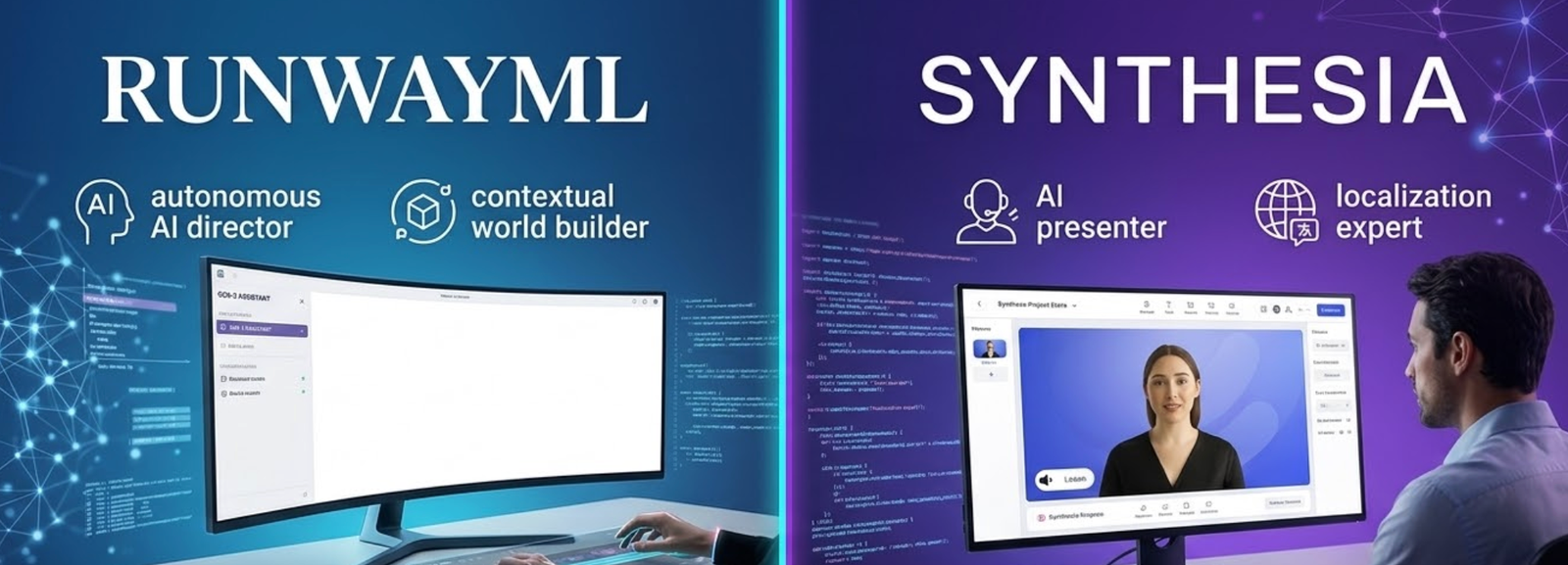

RunwayML vs Synthesia in 2026: The Ultimate AI Video Tool Showdown
📑 Table of Contents
🎯 Quick Verdict
The choice between RunwayML vs Synthesia in 2026 presents a clear decision based on your specific video production needs. Runway excels at generative AI for cinematic B-roll and creative visuals, while Synthesia leads in avatar-based corporate videos, training, and multilingual content.
The landscape of AI video creation has dramatically evolved by 2026, offering sophisticated tools that cater to vastly different production needs. Among the frontrunners, RunwayML vs Synthesia in 2026 stands out as a critical comparison for anyone looking to leverage artificial intelligence for video production, whether for cinematic projects or corporate communications. These platforms, while both utilizing AI for video generation, approach the creative process from fundamentally distinct angles, making the choice between them dependent on specific project goals and workflow requirements.
Our in-depth analysis, informed by AdwaitX’s 2026 evaluation data, reveals that selecting the right AI video tool is less about identifying a universally “better” option and more about aligning a platform’s strengths with your strategic objectives. Runway’s generative AI excels at producing original, creative visual content and B-roll from scratch, ideal for marketing and experimental projects. In contrast, Synthesia specializes in efficient, scalable production of avatar-based videos perfect for training, onboarding, and global communication efforts.
This comprehensive guide delves into their core functionalities, pricing structures, performance metrics, and optimal use cases. We will explore how Runway’s Gen-4.5 models empower visual artists and marketers to create unique scenes and effects, delivering cinematic 4K output. Simultaneously, we will examine Synthesia’s 2026 enhancements, including its expansive avatar library and 140+ language support with auto lip-sync, which streamline multilingual content distribution.
Understanding these differences is crucial for making an informed investment, ensuring your chosen AI video platform enhances productivity and achieves desired outcomes without unnecessary costs or workflow bottlenecks. By the end of this article, you will have a clear picture of which platform—RunwayML or Synthesia—is the ideal fit for your specific video production challenges in 2026, or if a hybrid approach combining both tools is the most effective strategy.
⚡ Performance Comparison
Overview: AI Video Tools in 2026
In 2026, the landscape of AI video generation is segmented into two primary approaches: generative scene creation and avatar-driven presentations. RunwayML, a pioneer in the generative AI space, offers tools that create entirely new video content from textual prompts or image references. Its strength lies in producing original visual narratives, cinematic B-roll, and abstract content that would be challenging or expensive to capture through traditional filming methods. This capability makes Runway invaluable for creative agencies, filmmakers, and marketers pushing the boundaries of visual storytelling.
Synthesia, on the other hand, dominates the market for professional avatar-based videos. It enables users to generate “talking-head” style videos featuring realistic AI presenters delivering scripts in over 140 languages with perfect lip-sync. This platform is meticulously engineered for corporate applications, including employee training, onboarding modules, compliance videos, and large-scale multilingual content distribution. Synthesia’s minute-based pricing model and rapid content update capabilities provide a significant advantage for organizations that require consistent, professional video communication at scale.
The core distinction, as highlighted by AdwaitX’s 2026 evaluation, is philosophical: Runway generates visual scenes, while Synthesia presents information through digital avatars. Runway’s Gen-4.5 models have advanced to offer improved character consistency, complex camera movements, and stunning 4K resolution exports for its Pro and Unlimited tiers. These advancements make it a powerful tool for intricate visual effects and unique background generation. Users can prompt the AI to animate specific styles and establish visual identities from reference images, providing a level of creative control previously reserved for seasoned VFX artists.
Conversely, Synthesia’s 2026 lineup boasts an expanded library of over 230 avatars for enterprise users, along with enhanced capabilities for custom avatar creation. Its one-click translation and automatic lip-sync features are unparalleled, dramatically reducing the time and cost associated with localizing video content for global audiences. For businesses needing to convey information clearly and consistently across diverse linguistic groups, Synthesia offers a robust and user-friendly solution. Understanding these fundamental differences is the first step in deciding which of these powerful AI video tools best serves your project’s unique demands.
Unpacking Key AI Video Features
The functionality offered by AI video tools has expanded significantly, moving beyond basic automation to sophisticated generative capabilities and hyper-realistic presentations. RunwayML and Synthesia, while both leading innovators, specialize in distinct sets of features tailored to their unique value propositions. Let’s delve into the specific advancements and capabilities that define these platforms in 2026.
Generative AI for Original Scenes (RunwayML)
RunwayML’s standout feature is its cutting-edge generative AI, which allows users to create original video scenes from text prompts and reference images. Models like Gen-4 and the newer Gen-4.5 are at the forefront of this capability. Gen-4, for instance, produces 5–10 second clips at 720p with a stable 24 FPS, maintaining character and background consistency across multiple generations through its advanced scene memory. This is particularly useful when creating B-roll footage that perfectly matches your brand’s aesthetic or generating abstract visual effects that don’t exist in traditional stock libraries.
The workflow typically involves uploading a reference image to guide the AI’s visual style, then crafting detailed text prompts to describe the desired animation, camera movement, and atmospheric conditions. For example, a marketing team might upload an image of a new product and prompt Runway to “animate a sleek, futuristic car driving through a neon-lit city at night with dynamic camera pans.” The Gen-4.5 update has further refined text-to-video capabilities, making prompt adherence more precise. The Pro plan enhances this by adding 4K upscaling, crucial for broadcast-quality content, allowing creators to produce cinema-grade output without extensive traditional post-production processes.
Avatar-Based Professional Presentations (Synthesia)
Synthesia’s core strength lies in its sophisticated avatar-based video creation, designed for delivering professional, consistent presentations. Instead of generating scenes, Synthesia focuses on producing “talking-head” videos where AI avatars deliver scripts with lifelike speech and synchronized lip movements. The platform’s 2026 iteration offers an impressive range of avatars, with Starter plans including over 125, Creator plans expanding to 180+, and Enterprise customers gaining access to 230+ options. For organizations, this means a consistent brand voice and visual representation across all internal and external communications.
A key enhancement in the Creator plan is the ability to develop personal, custom avatars. Users can train Synthesia’s AI with their own footage to create a digital twin that mimics their appearance, voice, and mannerisms. This feature is invaluable for executives, sales teams, or trainers who want to scale their personalized video outreach without physically filming every message. For example, a CEO could create a custom avatar to deliver personalized quarterly updates to employees worldwide, maintaining a consistent executive presence effortlessly.
👤 Avatar & Digital Twin “Power Prompts”
Use these prompts to leverage Synthesia’s 230+ avatars or your own AI Digital Twin. Scale your presence without ever stepping in front of a camera again.
Act as an Executive Communications Expert. Write a sophisticated 90-second quarterly update script for a CEO's Custom Avatar. The script must sound deeply personal, maintaining a consistent executive presence while delivering complex global updates. Use a "Vision-to-Action" structure that inspires employees worldwide without the need for a physical film shoot. Tone: Authoritative, transparent, and inspiring.
Generate a professional presentation script for a training video using one of Synthesia’s 230+ Enterprise avatars. The goal is to provide a consistent brand voice for a multi-lingual onboarding program. Ensure the script is optimized for perfect lip-syncing and natural "talking-head" delivery. Break the script into clear modules that allow the avatar to act as a 24/7 personal trainer for new hires. Tone: Professional, consistent, and welcoming.
Write a high-converting, personalized 45-second sales pitch script designed for a Custom Personal Avatar. This "Digital Twin" needs to deliver a message that feels like a 1-on-1 Zoom call. Focus on the benefits of scaling personalized outreach without the physical time cost of filming individual videos. Use a "Hook-Value-Ask" framework that makes the prospect feel like you are speaking directly to them. Tone: Personable, persuasive, and professional.
Multilingual Support and Localization (Synthesia)
Synthesia truly shines in its robust language and localization capabilities, a feature virtually absent in RunwayML. The platform supports over 140 languages with automatic lip-sync, meaning a single source video script can be translated and deployed across numerous linguistic markets with a single click. This eliminates the painstaking and expensive process of reshooting videos, hiring multiple voice actors, or manually editing lip movements for different languages. It’s a game-changer for multinational corporations and global marketing campaigns.
Consider a global company launching a new product. Traditionally, creating a 3-minute product demo in five languages would require multiple shoots, translations, voiceovers, and editing sessions, potentially taking weeks. With Synthesia Creator, the same 3-minute video translated into five languages consumes just 15 minutes from the annual allocation, translating into significant time and cost savings. While Runway allows for English audio generation with some models, it completely lacks the integrated multilingual voiceover and precise lip-sync crucial for global content distribution, making Synthesia the clear leader for international communication.
High-Resolution Export and Creative Control (RunwayML)
For projects demanding the highest visual fidelity, RunwayML offers superior export quality and granular creative control. Its Pro plan unlocks 4K resolution export (3840×2160), a critical requirement for broadcast-quality content, high-end commercials, and feature film production. This capability ensures that Runway-generated clips can be seamlessly integrated into professional editing pipelines alongside traditional footage without sacrificing visual integrity. The platform’s focus on generative techniques means creators aren’t limited by existing stock footage, allowing for truly unique and bespoke visuals.
Runway’s Gen-4 Turbo model, for example, renders 10-second clips in approximately 30 seconds, providing rapid iteration cycles for creative exploration. Filmmakers can quickly prototype complex scene ideas, test different camera angles, or experiment with various visual styles based on textual prompts and image references. This level of creative autonomy, combined with high-resolution output and advanced scene memory for consistent continuity, positions Runway as the tool of choice for artists and production studios focused on innovative, visually striking content that cannot be achieved with static avatar videos.
Pricing Comparison: Credits vs. Minutes
Understanding the pricing models of RunwayML and Synthesia is paramount, as they employ fundamentally different structures that cater to distinct usage patterns. Runway operates on a credit-based system, while Synthesia utilizes an annual minute-based subscription. This difference profoundly impacts cost-effectiveness depending on your video production needs and volume, making a detailed RunwayML vs Synthesia in 2026 pricing breakdown essential.
RunwayML’s pricing tiers start with a Free plan offering 125 one-time credits, ideal for basic exploration. The Standard plan costs $12/month (or $144/year) and provides 625 monthly credits along with access to all AI workflows, Gen-4.5, and watermark removal. For more serious creators, the Pro plan at $28/month (or $336/year) includes 2,250 credits, 4K export, and custom voices. The top-tier Unlimited plan, priced at $76/month (or $912/year), offers 2,250 credits plus unlimited video generation in Explore Mode at a relaxed rate, and Gen-3 Alpha Turbo access. A typical 10-second Gen-4 clip consumes 80–200 credits, depending on resolution and upscaling, meaning a Pro user could generate 22–45 clips per month before hitting their limit. This model favors short, punchy, creative content or B-roll segments.
Synthesia’s subscription structure, in contrast, bills by annual video minutes, making it highly advantageous for longer-form corporate content. The Basic free plan includes 10 minutes per month and 9 avatars, useful for platform exploration. The Starter plan is $29/month (or $264/year, effectively $22/month) and grants 120 minutes of annual video creation, along with 125+ avatars, downloads, and AI dubbing. The Creator plan, priced at $89/month (or $804/year, effectively $67/month), expands to 360 annual minutes, 180+ avatars, personal avatar creation, and API access. Enterprise customers receive custom pricing for unlimited video minutes, 230+ avatars, SSO, and priority support. A 5-minute training video, regardless of edits or retakes, consumes exactly 5 minutes from your annual allocation, making it predictable and cost-effective for lengthy corporate videos.
| Plan | RunwayML (Credits/Month) | Synthesia (Minutes/Year) |
|---|---|---|
| Free Tier | 125 one-time credits | 10 min/month |
| Standard/Starter | $12/month (625 credits) | $29/month or $264/year (120 min) |
| Pro/Creator | $28/month (2,250 credits, 4K) | $89/month or $804/year (360 min, custom avatars, API) |
| Unlimited/Enterprise | $76/month (2,250 + unlimited explore) | Custom pricing (Unlimited min, 230+ avatars, SSO) |
When analyzing cost per video, real-world scenarios highlight the disparity. A 30-second marketing ad with B-roll on Runway Pro might cost 150–300 credits, approximately 13% of a monthly allocation. However, a 5-minute employee training video would consume 1,500–3,000 credits, likely exceeding the monthly Pro limit and requiring additional credit purchases or an upgrade. The same 5-minute video on Synthesia Creator would use only 5 minutes from a 360-minute annual pool, representing just 1.4% of the allocation. For multilingual product launches, RunwayML is not feasible due to lack of multilingual support, while Synthesia Creator would handle 15 minutes of content (5 languages x 3 minutes) for only 4.2% of its annual pool.
Therefore, for short, creative, visually dynamic content, RunwayML’s credit-based system offers value, especially with 4K output. But for any long-form content, particularly training, onboarding, or multilingual communication, Synthesia’s minute-based model offers significantly better cost-efficiency and predictability. Businesses should carefully calculate their projected video output length and type before committing to either platform to ensure maximum ROI.
Best Use Cases for Each Platform
The choice between RunwayML and Synthesia hinges critically on specific project requirements and the desired video output. Both platforms offer unique advantages, making them indispensable for particular applications in the rapidly evolving AI video landscape of 2026. Here, we outline the optimal scenarios for each tool, drawing directly from AdwaitX’s comprehensive evaluation.
Use Case 1: Cinematic B-roll for Marketing Campaigns (RunwayML)
Problem: A creative agency needs unique, captivating B-roll for a luxury brand’s marketing campaign. Stock footage is too generic, and traditional film shoots are prohibitively expensive and time-consuming for conceptual shots. The agency requires visuals that are abstract, high-quality, and align perfectly with a specific, imaginative brief.
Solution: The agency leverages RunwayML’s generative AI (Gen-4.5) to produce custom cinematic B-roll. They upload mood board images to set the visual style and then use precise text prompts, such as “a shimmering liquid metal flowing over futuristic cityscapes under a twilight sky,” to generate 5-10 second clips. The 4K export from Runway’s Pro plan ensures broadcast-ready quality.
Outcome: Runway allows the agency to quickly generate several iterations of unique, high-quality B-roll footage that perfectly fits the brand’s sophisticated image. This drastically reduces production time and costs compared to traditional methods, enabling rapid concept visualization and client approvals. The final ad features truly original visuals that differentiate the brand.
Use Case 2: Large-Scale Corporate Training & Onboarding (Synthesia)
Problem: A multinational corporation needs to update its 10-minute employee onboarding video, which must be delivered in five different languages to a global workforce. The content frequently changes due to policy updates, making traditional video production cycles too slow and expensive for ongoing revisions.
Solution: The L&D department uses Synthesia’s Creator plan. They upload their script in English, select a professional AI avatar from the 180+ options, and then use Synthesia’s one-click translation feature to generate versions in French, German, Spanish, and Mandarin, all with automatic lip-sync. When policies change, they simply edit the script and regenerate the video, consuming minutes from their annual allocation.
Outcome: Synthesia enables the company to deploy consistent, high-quality training content across all regions almost instantly. The minute-based pricing makes iterative updates incredibly cost-effective. The professional avatars ensure a uniform and trustworthy presentation, drastically reducing the administrative burden and accelerating employee training globally.
Use Case 3: Experimental Marketing & Visual Storytelling (RunwayML)
Problem: A tech startup wants to launch a viral campaign featuring surreal, dreamlike visuals to showcase an innovative new product. They need to create unique visual effects and abstract animations that convey complex ideas without relying on human actors or traditional animation studios.
Solution: The marketing team utilizes RunwayML’s Gen-4.5 and Gen-3 Alpha models for text-to-video and image-to-video generation. They experiment with prompts like “a quantum entanglement visualized as shimmering threads connecting celestial bodies” or “an abstract representation of data flow within a living neural network.” Runway’s ability to handle complex atmospheric requirements and cinematic camera movements is crucial here.
Outcome: Runway provides the flexibility and creative freedom to generate truly novel visual assets for the campaign. The ability to iterate quickly and produce unique motion graphics allows the startup to stand out in a crowded market, capturing attention with visually striking content that is impossible to replicate with stock footage or avatar-based tools.
Use Case 4: Personalized Sales Outreach and Customer Success Videos (Synthesia)
Problem: A SaaS sales team wants to send personalized video messages to hundreds of prospective clients, introducing new features or offering tailored solutions. Creating individual videos for each prospect by human presenters is unscalable and time-consuming.
Solution: The sales team, using Synthesia’s Creator plan, creates custom avatars for their key sales representatives. They then use the API access to programmatically generate videos, merging individual prospect names and company details into a base script. Each video features the sales rep’s custom avatar, delivering a highly personalized message.
Outcome: This strategy allows for hyper-personalized outreach at scale, significantly improving engagement rates. Prospects receive a video that feels directly addressed to them, strengthening the connection without the sales team spending hours recording individual messages. The custom avatars maintain brand consistency and familiarity.
Use Case 5: Software Tutorials and Product Demos (Hybrid Workflow)
Problem: A software company needs to produce engaging tutorials for its complex platform, featuring both screen recordings of the UI and professional narration. They want the tutorials to look polished and visually appealing, not just a simple screen capture with a voiceover.
Solution: This scenario benefits from a hybrid approach. First, the team generates unique, branded abstract backgrounds and motion graphics in RunwayML for the introductory and transitional segments. These are exported as MP4 files. Second, these Runway clips are imported into Synthesia as custom backgrounds. Then, Synthesia avatars are used to narrate the screen-recorded software demonstrations, ensuring professional delivery and easy multilingual translation. Screen recording features within Synthesia can capture the software interaction directly.
Outcome: By combining Runway’s generative capabilities for dynamic visuals with Synthesia’s professional avatar narration and screen recording, the company creates highly engaging, brand-consistent, and easily localizable software tutorials. This hybrid workflow offers unmatched generative visuals paired with realistic avatar performances, delivering a superior viewing experience that accelerates user adoption and understanding.
Pros and Cons
✅ Pros
- RunwayML: Exceptional generative AI for creating original scenes and B-roll. This capability allows users to produce visuals that are truly unique and cannot be found in stock libraries, fostering unparalleled creative freedom for filmmakers and marketers.
- RunwayML: 4K export quality suitable for broadcast and commercial work. Professionals can output videos at 3840×2160 resolution, meeting industry standards for high-end projects and ensuring visual fidelity for large screens or cinematic presentations.
- RunwayML: Gen-4 scene memory maintains character and background consistency across clips. This advanced feature greatly simplifies the workflow for creating longer sequences, as the AI intelligently preserves visual elements, reducing manual editing for continuity.
- Synthesia: 140+ language support with automatic lip-sync. This is a game-changer for global communication, allowing a single video to be localized for vast international audiences instantly, saving immense time and resources on translation and re-recording.
- Synthesia: Minute-based pricing is ideal for long-form training content and predictable budgeting. Unlike credit-based systems, generating a 10-minute video consistently consumes 10 minutes from an annual allocation, making it highly cost-effective for extensive corporate video libraries.
- Synthesia: Offers 125–230+ avatars depending on the plan tier, including custom avatar creation. This provides a wide range of professional presenters and the ability for individuals or brands to create their own digital likenesses for highly personalized content.
❌ Cons
- RunwayML: High credit consumption makes long-form video prohibitively expensive. Generating even a 5-minute training video with Runway would require numerous clips and exceed most monthly credit allocations, making it impractical for continuous or lengthy content.
- RunwayML: 5–10 second clip length limitation per generation requires significant manual stitching for longer sequences. This constraint can be tedious for narrative projects or any video requiring extended, continuous shots, adding to post-production workload.
- RunwayML: Steep learning curve for prompt engineering and model selection. New users may find it challenging to achieve desired results without mastering specific prompting techniques and understanding the nuances of different generative models.
- Synthesia: No original scene generation or B-roll creation capabilities. The platform is designed for avatar-led presentations, meaning users cannot generate custom environments, abstract visuals, or dynamic B-roll footage, limiting creative visual storytelling.
- Synthesia: Static camera angles with limited cinematography options. Videos typically feature fixed camera positions, lacking dynamic pans, zooms, or complex tracking shots that can add cinematic flair, making it less suitable for highly engaging, visually varied content.
- Synthesia: Pronunciation can vary with technical jargon and brand names, requiring manual phonetic corrections. While generally accurate, specific industry terms or unique brand pronunciations may occasionally need adjustments to ensure perfect delivery.
Final Verdict: Choosing Your AI Video Powerhouse
The decision between RunwayML and Synthesia in 2026 ultimately boils down to a clear understanding of your video production objectives. Both are powerful AI video tools, but they address entirely different segments of the video creation pipeline. RunwayML stands as the undisputed champion for creative, generative content, specializing in crafting unique visual narratives and cinematic elements from scratch. Synthesia, conversely, is the powerhouse for scalable, professional avatar-based presentations, particularly excelling in corporate communication and global content localization.
For creative professionals, marketing agencies, and filmmakers focused on pushing visual boundaries, RunwayML offers unmatched generative capabilities. If your goal is to produce stunning 4K B-roll, experimental marketing content, or visually complex animations that defy traditional stock libraries, Runway’s Gen-4.5 models and credit-based system will empower your vision. Its strength lies in its ability to bring abstract concepts to life, provide dynamic camera movements, and maintain visual consistency across short, impactful clips. However, be mindful of the credit consumption for longer projects and the inherent learning curve associated with advanced prompt engineering.
On the other hand, for enterprises, HR departments, L&D teams, and global marketing operations, Synthesia provides a streamlined, cost-effective solution for consistent, high-volume video communication. If your primary need is to create professional training modules, onboarding videos, compliance updates, or multilingual product launches with human-like presenters, Synthesia’s minute-based pricing, extensive avatar library, and superior 140+ language support are invaluable. Its simplicity and one-click update functionality drastically reduce production cycles and ensure brand uniformity across all communications. While it lacks generative visual flair, its focus on clear, localized presentation is unparalleled.
Ultimately, the “better” platform depends entirely on your specific use case. Teams requiring original, high-fidelity visual assets for short-form creative projects should lean into RunwayML. Organizations prioritizing consistent, professional presentations, scalable training, and efficient multilingual content distribution will find Synthesia to be the superior investment. For the most advanced and flexible workflows, a hybrid approach combining Runway’s generative backgrounds with Synthesia’s avatars for narration represents the best of both worlds, although it requires subscriptions to both services. Evaluate your core needs, project length, and desired output quality to make the optimal choice among these leading AI video tools in 2026.
❓ Frequently Asked Questions
Is RunwayML better than Synthesia?
It depends entirely on your use case. RunwayML is better for creative, generative video content — cinematic B-roll, abstract visuals, and experimental marketing. Synthesia is better for corporate communications — training videos, onboarding, and multilingual presentations with AI avatars. They serve fundamentally different purposes and are not direct competitors.
Does RunwayML have a free plan?
Yes. RunwayML offers a free tier with 125 one-time credits, which is enough to explore the platform and generate a handful of short clips. Paid plans start at $12/month for 625 monthly credits. Note that a typical 10-second Gen-4 clip consumes 80–200 credits depending on resolution, so the free tier is best for initial testing.
How many languages does Synthesia support?
Synthesia supports over 140 languages with automatic lip-sync, meaning a single video script can be translated and deployed across global markets with one click. This makes it the leading choice for multinational organizations that need consistent, localized video content without reshooting or hiring multiple voice actors.
Can Synthesia create custom AI avatars?
Yes, but only on the Creator plan ($89/month) and above. Users can train Synthesia with their own footage to create a personal digital twin that replicates their appearance, voice, and mannerisms. This is particularly useful for executives, trainers, and sales teams who want to scale personalized video outreach without filming every message individually.
Can RunwayML and Synthesia be used together?
Yes, and this hybrid approach is highly effective. You can generate branded motion graphics or abstract backgrounds in RunwayML, export them as MP4 files, then import them into Synthesia as custom video backdrops. Synthesia avatars then narrate over these visuals, combining RunwayML’s generative creativity with Synthesia’s professional presentation and multilingual capabilities.
Ready to Get Started?
Try RunwayML Free → Try Synthesia Free →No credit card required for basic access
Latest Articles
Browse our comprehensive AI tool reviews and productivity guides
GitHub Copilot Pricing 2026: AI Credits Explained
GitHub Copilot Pricing 2026: AI Credits Explained
GitHub Copilot pricing in 2026 has shifted to AI Credits, impacting heavy users more than basic autocomplete.
Claude Fable 5 Review: Anthropic’s Most Powerful Public AI Model (2026)
Claude Fable 5 Review: Anthropic’s Most Powerful Public AI Model (2026)
Anthropic launched Claude Fable 5 on June 9, 2026 — their first Mythos-class model available to the general public. We break down its capabilities, safeguards, pricing, and how it stacks up against the competition.
Claude for Small Business Review (2026)
Claude for Small Business Review (2026)
Anthropic's Claude for Small Business ships with 15 ready-to-run AI workflows inside tools like QuickBooks, PayPal, HubSpot, and Canva. We break down what it does, who it's for, and whether it's worth your time.
Generative Engine Optimization (GEO) 2026: How to Get Your Content Cited by...
Generative Engine Optimization (GEO) 2026: How to Get Your Content Cited by ChatGPT, Perplexity & Google AI
Traditional SEO gets you ranked. GEO gets you cited. With 60% of searches now ending without a click and AI Overviews slashing organic CTR by 58%, getting your content into AI answers is the new growth channel. Here's the complete playbook for 2026.
Perplexity Projects Explained: New Workflow System
Perplexity Projects Explained: New Workflow System
Perplexity Projects are changing AI research with a new workflow system that enhances productivity and streamlines complex tasks.
Bika.ai Review: No-Code Agentic Database for AI
Bika.ai Review: No-Code Agentic Database for AI
Is Bika.ai the no-code agentic database solution you've been searching for? This review breaks down its features, pricing, and potential.
Gumloop Review 2026: Drag-and-Drop AI for Founders
Gumloop Review 2026: Drag-and-Drop AI for Founders
A comprehensive Gumloop review for non-technical founders, evaluating its drag-and-drop AI capabilities, pricing, and suitability for business automation.
LangGraph vs AutoGen: Advanced State Management 2026
LangGraph vs AutoGen: Advanced State Management 2026
Compare LangGraph and AutoGen for advanced AI agent state management in 2026, detailing benchmarks, pricing, and real-world application differences.
Commonstack AI: Intelligent Model Routing Guide
Commonstack AI: Intelligent Model Routing Guide
Discover how Commonstack AI optimizes LLM usage with intelligent model routing for cost savings.
Clawbot AI Review 2026: Multi-Agent Orchestration Compared
Clawbot AI Review 2026: Multi-Agent Orchestration Compared
An in-depth look at Clawbot AI versus CrewAI for multi-agent orchestration, examining their capabilities, pricing, and ideal use cases.
Claude Code vs n8n: Connecting AI for Auto-Healing Pipelines
Claude Code vs n8n: Connecting AI for Auto-Healing Pipelines
Explore Claude Code vs n8n for agentic workflows, detailing their strengths in code automation and business process integration.
DeepSeek V4 Review 2026: The Largest Open-Weight Model Ever — Pro, Flash,...
DeepSeek V4 Review 2026: The Largest Open-Weight Model Ever — Pro, Flash, Benchmarks & Pricing
DeepSeek V4 Review 2026: The Largest Open-Weight Model Ever — and the Biggest Disruption to AI Pricing